


CourtSense Pro
CourtSense Pro
 Unfiltered Court Feel
 Natural Toe Spread
 Stability Without The Brick
 Lighter Footwork
Couldn't load pickup availability
Sizing Chart

 consider buying one size higher if you have wide feet
-
Ordered
- - -
Order Ready
- - -
Delivered

CourtSense Pro
Is a minimalist-style shoe stable enough for pickleball?
Is a minimalist-style shoe stable enough for pickleball?
Yes — because stability does not only come from bulky sidewalls.
CourtSense Pro uses a wide toe box, low-to-court platform, flexible sole, and court-ready traction to help your foot create a more natural base during lateral movement.
The goal is not to feel loose or exposed. The goal is to feel grounded without dragging around a heavy, stiff shoe.
Will my feet hurt if I’m used to traditional court shoes?
Will my feet hurt if I’m used to traditional court shoes?
CourtSense Pro will feel different at first because your feet, ankles, calves, and Achilles are asked to participate more.
That is part of the reconditioning process.
If you are used to thick cushioning or heavy support, transition gradually. Start with shorter sessions, warmups, drills, or lighter play before using them for long, intense matches.
Soreness can be part of adaptation. Sharp pain means stop and give your body more time.
How should CourtSense Pro fit?
How should CourtSense Pro fit?
Your toes should have room to open naturally without feeling squeezed against the sides.
The shoe should feel secure through the heel and midfoot, with space in the forefoot. If the front feels roomy at first, that is intentional — your toes are supposed to have space to work.
Is the wide toe box only for people with wide feet?
Is the wide toe box only for people with wide feet?
No. The wide toe box is not just for “wide feet.”
It is designed to give the toes room to spread during movement. Even players with regular-width feet can benefit from more forefoot freedom, as long as the heel and midfoot feel secure.
The fit should feel locked in through the back of the shoe, with more natural space in the front.


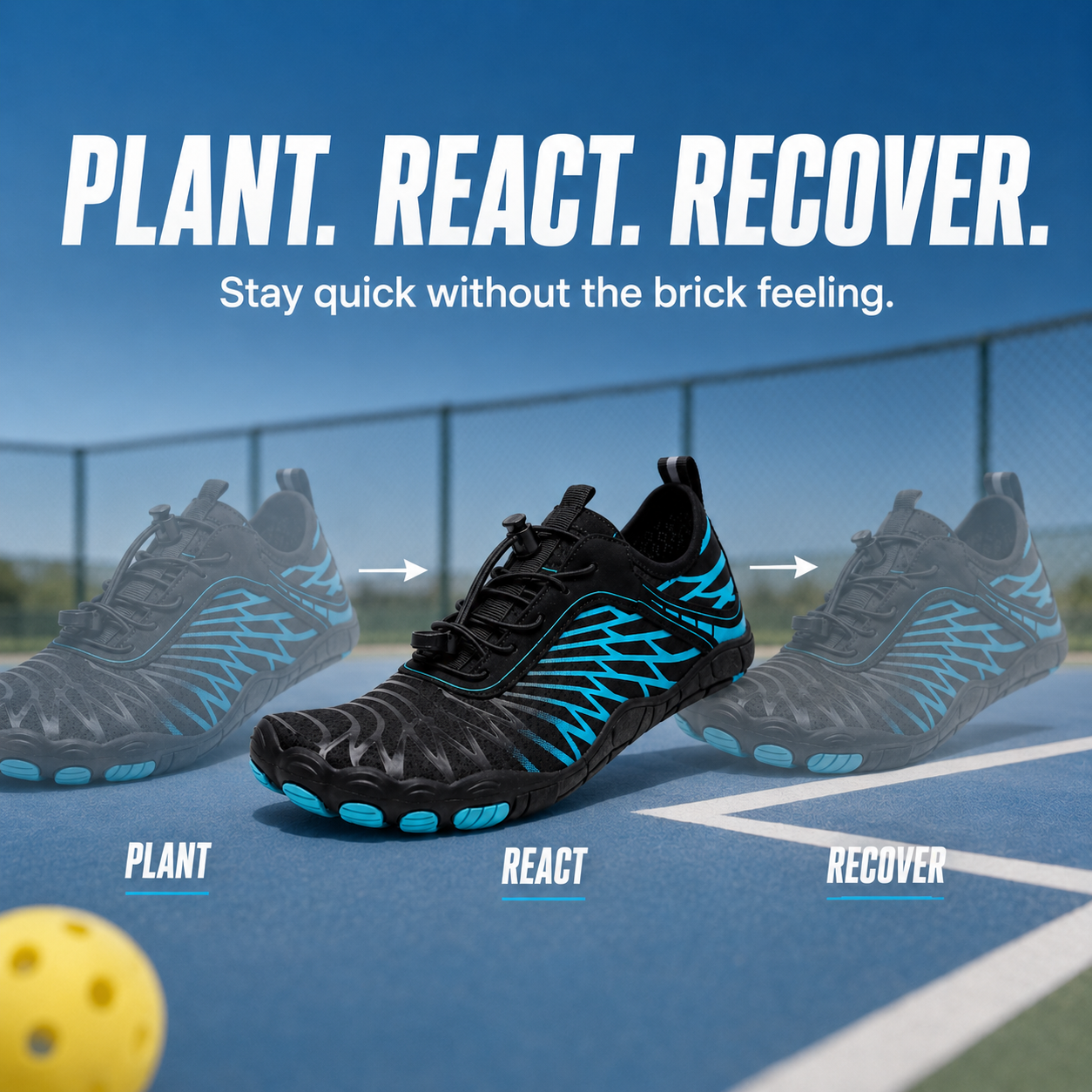


Court feel is not a comfort feature. It is movement information.
Walk barefoot on a beach and you know exactly where the sand dips. Nobody tells you. Your feet read the ground and your body adjusts before you even think about it.
That's what your feet try to do on every step on the court: feel where your weight is, how much grip you have, when you're about to slide.
Now put a thick layer of foam between your foot and the court. The information is still there, but it arrives late and blurry. That split second of delay is when you plant a little late, lunge a little short, or catch yourself off balance.
CourtSense Pro uses a thin, flexible sole that keeps your foot close to the court. Not to leave it unprotected. To remove the layer that was hiding what your body needs to know.

Stability does not only come from stiff sidewalls.
Think about what you do when someone bumps into you. You don't lock up. You widen your stance. A wider base is what keeps you steady.
Most court shoes do the opposite. They squeeze your toes together, then build stability around the foot with stiff walls and a raised midsole. It feels secure in the store. But your foot ends up standing on a narrow base, held in place instead of balancing itself.
CourtSense Pro gives your forefoot room to open. When your toes can spread, your foot builds its own broader base, right where you need it: when you plant for a dink, push off sideways, or stop hard at the kitchen line.
And because the platform sits low to the court, you're not balancing on top of a stack of foam. Less height to wobble on. More foot on the ground.

Your foot is not just something you stand on. It is part of your movement system.
"Drop" is the height difference between the heel and the toes of a shoe. Most mainstream court shoes sit your heel higher than your forefoot, on a wedge of foam. It looks harmless. Your body doesn't treat it that way.
Stand on a ramp and your weight tips forward. Your posture adjusts around it, and your calves and Achilles spend every hour in the shoe in a slightly shortened position.
The raised, padded heel also invites you to land heel first, letting the foam take the hit instead of the natural springs in your foot.
And the stress doesn't disappear, it moves. Researchers found that raising a shoe's drop from 0 to 8 mm lowered the load on the ankle but increased it at the knee. A heel ramp doesn't remove the stress of the game. It pushes part of it up toward your knees.
CourtSense Pro has zero drop: heel and forefoot sit level, the way you stand barefoot. Your weight stays centered, your ready position comes from you instead of the shoe, and your feet, ankles and calves take back their share of the work.
Over 9,000 pairs of feet back on the court
-

I felt less like I was dragging my feet.
I was honestly a little skeptical at first because they don’t feel like my usual court shoes. They’re lower, less padded, and you notice it right away. But after a couple games, that’s kind of what I liked about them. I felt closer to the court, especially when I had to stop and push back the other way. I’m 54 and I’m not pretending shoes make me 25 again, but I did feel less like I was dragging my feet around.
-

My feet felt more awake.
The wide toe box is what sold me. My toes usually feel squeezed after playing, especially during longer sessions. These felt different. Not super cushy, not like walking on pillows, but more natural. I did take a little time to get used to them because my feet were working more than usual. After that, I started to like the feeling. My feet felt more awake, if that makes sense.
-

They don’t have that bulky feel.
I’ve tried a few pickleball shoes and most of them feel overbuilt to me. Supportive, sure, but kind of clunky. These don’t have that bulky feel. The first thing I noticed was how easy it was to move side to side without feeling like the shoe was fighting me. They’re not plush, so if you want a big soft shoe, this probably isn’t it. But for court feel and quick movement, I really like them.


