


CourtSense Pro
CourtSense Pro
 Unfiltered Court Feel
 Natural Toe Spread
 Stability Without The Brick
 Lighter Footwork
Couldn't load pickup availability
Sizing Chart

 consider buying one size higher if you have wide feet
-
Ordered
- - -
Order Ready
- - -
Delivered

CourtSense Pro
Is a minimalist-style shoe stable enough for pickleball?
Is a minimalist-style shoe stable enough for pickleball?
Yes — because stability does not only come from bulky sidewalls.
CourtSense Pro uses a wide toe box, low-to-court platform, flexible sole, and court-ready traction to help your foot create a more natural base during lateral movement.
The goal is not to feel loose or exposed. The goal is to feel grounded without dragging around a heavy, stiff shoe.
Will my feet hurt if I’m used to traditional court shoes?
Will my feet hurt if I’m used to traditional court shoes?
CourtSense Pro will feel different at first because your feet, ankles, calves, and Achilles are asked to participate more.
That is part of the reconditioning process.
If you are used to thick cushioning or heavy support, transition gradually. Start with shorter sessions, warmups, drills, or lighter play before using them for long, intense matches.
Soreness can be part of adaptation. Sharp pain means stop and give your body more time.
How should CourtSense Pro fit?
How should CourtSense Pro fit?
Your toes should have room to open naturally without feeling squeezed against the sides.
The shoe should feel secure through the heel and midfoot, with space in the forefoot. If the front feels roomy at first, that is intentional — your toes are supposed to have space to work.
Is the wide toe box only for people with wide feet?
Is the wide toe box only for people with wide feet?
No. The wide toe box is not just for “wide feet.”
It is designed to give the toes room to spread during movement. Even players with regular-width feet can benefit from more forefoot freedom, as long as the heel and midfoot feel secure.
The fit should feel locked in through the back of the shoe, with more natural space in the front.


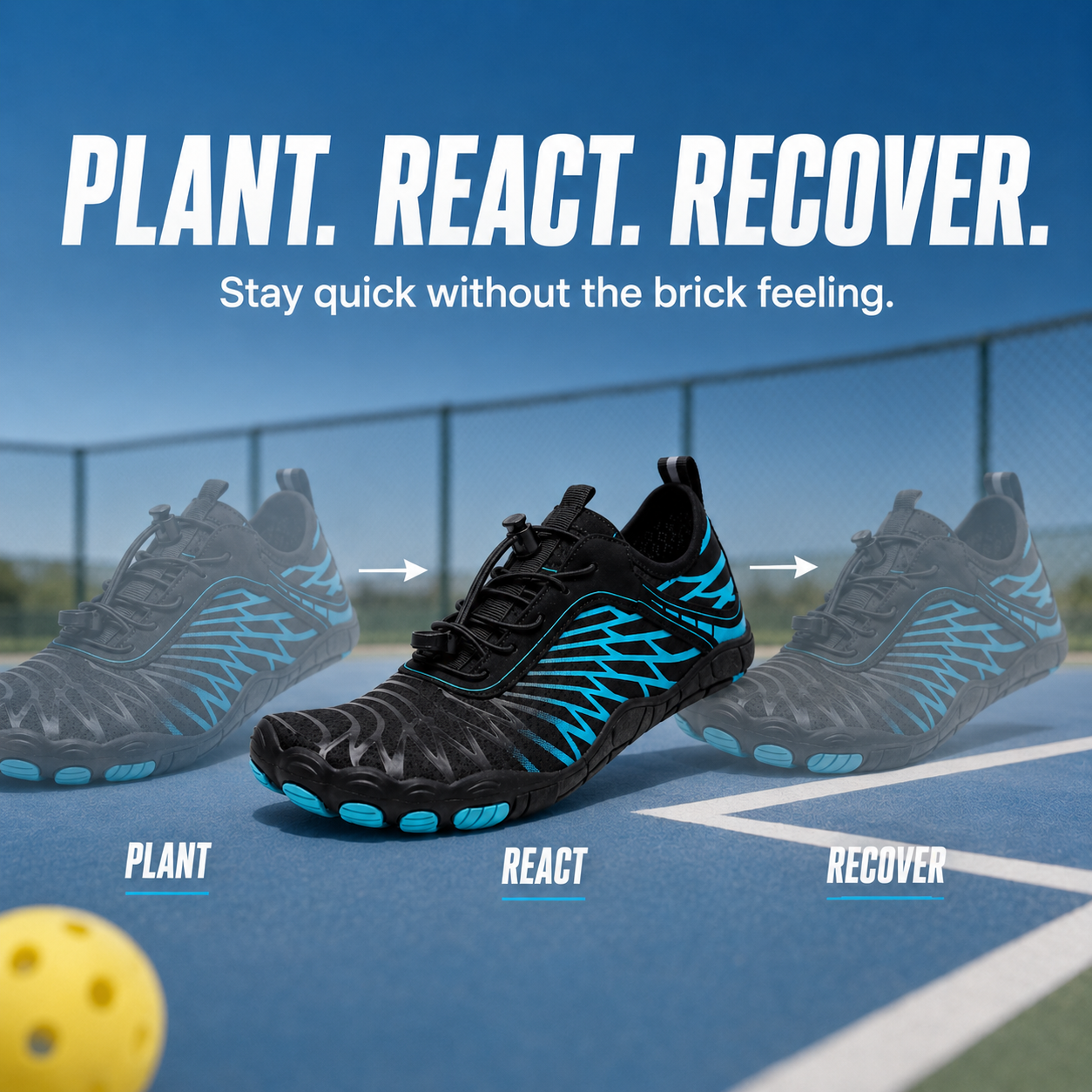

Court feel is not a comfort feature. It is movement information.
Every time your foot contacts the court, your body receives information.
Pressure, Angle, Grip, Weight shift, Balance.
That information helps your foot and ankle make small adjustments before the rest of your body commits to the movement.
The problem with many traditional court shoes is not that they are “bad.” It is that their thick cushioning and raised platforms can filter some of that information before your foot ever receives it.
CourtSense Pro is built with a lower-profile, more flexible sole so the foot stays closer to the playing surface.
The goal is not to make the shoe feel empty or unprotected.The goal is to reduce the amount of material between your foot and the court, so your body can read the surface more clearly during quick changes of direction.

Stability does not only come from stiff sidewalls.
Most court shoes create stability from the outside.
They add structure around the foot, build up the midsole, and lock the foot into a more controlled shape.
That can feel secure, but it can also limit how much the foot itself is allowed to contribute.
CourtSense Pro uses a different stability principle.
Instead of only bracing the foot from the outside, it gives the forefoot more room to open inside the shoe.
When the toes have space to spread, the foot can create a broader base against the court. That matters during plants, stops, lateral shifts, and push-offs because the base of support starts at the ground.
The low-to-court platform also helps reduce the elevated feeling that many players get from thick, stacked soles.
The result is a shoe designed to feel grounded without depending on excessive bulk.

Your foot is not just something you stand on. It is part of your movement system.
Modern court shoes often solve discomfort by doing more of the work for your foot.
They lift it higher, cushion more impact, hold the arch in place, compress the toes, and make the shoe responsible for stability.
Over time, the foot learns to move inside a controlled shell instead of sensing, spreading, loading, and stabilizing through movement.
Minimalist-style footwear reverses that relationship.
With more toe space, a flexible sole, and a lower-to-court platform, the foot receives more information and has more room to participate.
The toes can spread. The arch can load and rebound. The ankle receives clearer feedback. The calves, Achilles tendon, and lower leg are asked to work again. That matters for injury prevention. Stronger feet, more responsive ankles, and a lower leg that can absorb, stabilize, and react create a better foundation for safe movement on court.
CourtSense Pro is built around that principle:
Not more padding under the problem.
More participation from the system that controls the movement.
Approved by +9000 Feet
-

I felt less like I was dragging my feet.
I was honestly a little skeptical at first because they don’t feel like my usual court shoes. They’re lower, less padded, and you notice it right away. But after a couple games, that’s kind of what I liked about them. I felt closer to the court, especially when I had to stop and push back the other way. I’m 54 and I’m not pretending shoes make me 25 again, but I did feel less like I was dragging my feet around.
-

My feet felt more awake.
The wide toe box is what sold me. My toes usually feel squeezed after playing, especially during longer sessions. These felt different. Not super cushy, not like walking on pillows, but more natural. I did take a little time to get used to them because my feet were working more than usual. After that, I started to like the feeling. My feet felt more awake, if that makes sense.
-

They don’t have that bulky feel.
I’ve tried a few pickleball shoes and most of them feel overbuilt to me. Supportive, sure, but kind of clunky. These don’t have that bulky feel. The first thing I noticed was how easy it was to move side to side without feeling like the shoe was fighting me. They’re not plush, so if you want a big soft shoe, this probably isn’t it. But for court feel and quick movement, I really like them.


